Blacklow Cottage
Good Morning, Midnight (Reginald Hill Edition)Blacklow Cottage is Lavinia Maciver’s home, a country cottage whose garden and kitchen form a gentle counterworld to the bereavement and police investigation surrounding her nephew, Palinurus Maciver Junior. Hat Bowler first encounters it in a dream reshaped as a fairy tale; on later visits, its unlocked doors, birds, bread, and welcome become a source of solace that he is reluctant to leave.
Setting and First Appearance
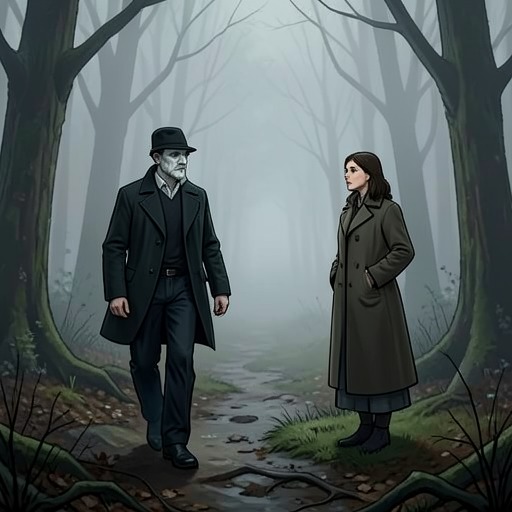
Hat’s first approach to Blacklow Cottage unfolds in a dream. He imagines himself lost in a forest and casts the house as the gingerbread trap of Hansel and Gretel, with Lavinia as the Crunch Witch. His fear loses force when he realizes he is not hungry and does not even like gingerbread. A blackbird’s alarm call stops him outside the house, where the supposed witch appears: a square-faced woman with grey hair coiled beneath a small feathery hat, repaired round spectacles, a blue T-shirt, green slacks, Wellington boots, and a rough walking stick. The scene’s fairy-tale menace is undercut by the ordinary, slightly familiar woman in the doorway.
The dream’s apparent forest magic gives way to a recognizable garden when Hat asks whether it is hers. A ragged thorn hedge and ramshackle osier gate enclose rough grass dotted with tiny daffodils; beside a lean-to greenhouse, furrows mark a small kitchen garden still needing attention after winter. The cottage is not a confectionary snare but a lived-in rural home. Lavinia invites the unwell, breakfastless Hat inside, and he accepts on the condition that the food is not gingerbread. The transition from imagined danger to practical hospitality establishes the pattern that later visits deepen: his anxiety gives way to the comforts of food, birds, and company.
A Place of News and Bereavement
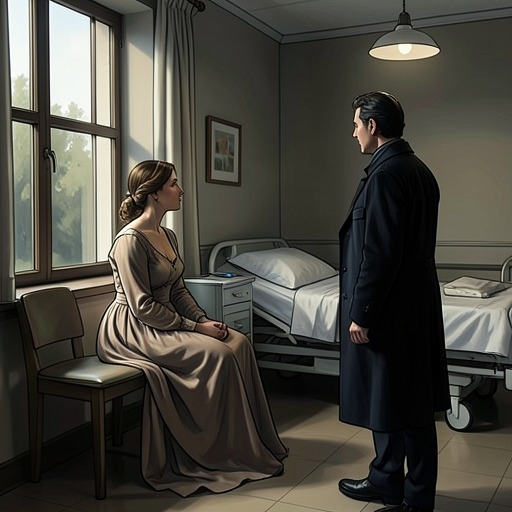
The cottage is also where Laurence Waverley brings Lavinia news of her nephew’s death. He arrives carrying an ebony walking stick topped with a silver hawk’s head, wearing a black trilby, and addresses her with formal courtesy; she answers as an old acquaintance, telling him he could simply have come round the back. When he struggles to explain why he has come, Lavinia urges him to speak plainly. Waverley tells her that Palinurus Maciver Junior is dead, like her brother, and confirms that he killed himself the previous night at Moscow House. The house therefore receives a family tragedy at close quarters, in a conversation between people whose familiarity contrasts with the starkness of the news.
On a later morning Hat again drives towards the cottage, despite recognizing that turning up repeatedly would be an imposition. He sees that the roadside place where Waverley had parked is occupied by an Alfa Spider, and initially tries to treat his arrival as a detective’s observation rather than a personal visit. At the cottage, a distressed woman is accusing Lavinia of having a financial motive in her late husband’s visit and threatening to challenge the will. Lavinia denies that money was discussed and recalls Palinurus taking unusual pleasure in watching the birds. The visitor drives away; Hat, who has been welcomed into the kitchen, hears her car depart and then the more sedate arrival of Waverley’s Jaguar. The cottage thus becomes a setting where grief, inheritance, family distrust, and Lavinia’s memories of her nephew meet, while Hat remains close enough to hear their aftermath without witnessing the whole confrontation.
The Garden and Kitchen as Refuge
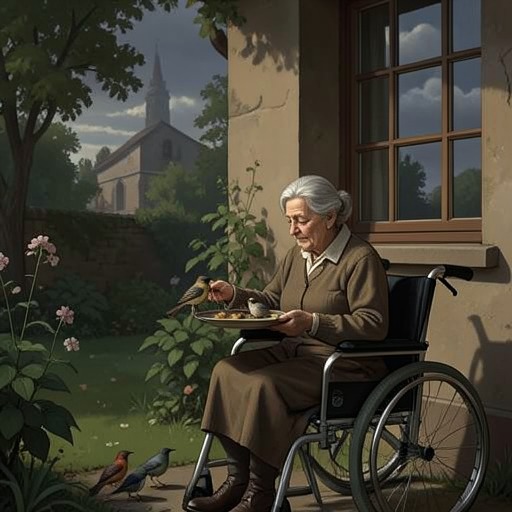
The interior makes the cottage’s hospitality tangible. When Hat enters, tea, butter, marmalade, and a half-loaf covered by a tea towel are laid out on the kitchen table. Bullfinches tug at the cloth while other birds wait nearby. Hat pours tea and cuts himself bread; crumbs bring tits down to compete for what he leaves. The birds do not vanish at his arrival: a few flee, but others retreat to the ceiling beam and curtain rail. Their presence makes the kitchen less a sealed domestic interior than a shared space, open to the life of the garden.
That openness is repeated in Hat’s later visits. After waking in better spirits than he has felt for weeks, he remembers not the dark forest of the earlier dream but budding fruit trees with nesting birds. Finding nothing appealing in his fridge, he drives towards Blacklow Cottage before fully acknowledging that he may be imposing on Lavinia. The smell of fresh-baked bread, her welcoming smile, and the excited flutter of wings bring him contentment as soon as he enters. At another visit, Laurence Waverley is already seated at the kitchen table. Hat’s familiarity with the house is evident in the confidence with which he leads Peter Pascoe inside; the smell of baking and the warmth of Lavinia’s welcome make him feel at home without needing to pretend.
Visits, Care, and Narrative Significance
Hat’s attachment to the cottage grows alongside his attempts to return to ordinary life. He is officially still sick and resents being kept away from Blacklow Cottage, where fresh bread shared with Lavinia’s birds seems better therapy than a Saturday at his desk. Yet the repeated visits also expose his difficulty respecting the boundary between personal need and another person’s privacy. On the morning he drives there again, he notices the occupied roadside parking place and recognizes that his reasons for continuing are increasingly implausible. The cottage offers comfort, but the narrative also makes Hat aware that comfort does not automatically justify arriving uninvited.
For Peter Pascoe, the cottage’s open windows and doors and the birds flying in and out initially suggest disorder. That impression changes when Lavinia invites him to sit and serves tea and scones. He reflects that the only time he bent the rules was for little more than a buttered scone, and wonders whether even Andy Dalziel’s fall could have begun with so small a temptation. Lavinia’s welcome therefore affects not just Hat’s recovery but the conduct and judgment of the investigators who enter her home. After speaking with Waverley, Pascoe watches the Jaguar leave and returns to the cottage; when he tells Hat it is time to go, Lavinia asks whether there was something he wanted to ask her. The question leaves the cottage’s role open-ended: it is at once a domestic refuge, a place of disclosure, and a threshold where hospitality can invite further inquiry.